Why we ran this survey
Most AI research focuses on model performance, investment or predictions about jobs. We wanted to look at something more immediate: the small, repeated choices people make when AI becomes part of an ordinary day.
So we asked a few straightforward questions.
- How often do people open an AI tool?
- What do they use it for?
- How much time does it save?
- How carefully do they check the answer?
- Could they still work without it?
The responses came from a community that includes working professionals, founders, and students. They do not represent every AI user, but they offer a useful snapshot of how quickly AI habits are forming, and where those habits may be getting ahead of good judgment.
TL;DR
AI is already part of the working day for this community. 98.2% use it daily, and 64.4% say it gives them back a few hours or almost a full workday each week.
The habits around it are still catching up. 31.3% use most or all AI output without checking it, while one in five say they cannot work without it.
This report follows that tension: where AI creates genuine leverage, where trust gets ahead of verification, and how students, professionals and founders are adapting in different ways.
The headline: Adoption is no longer the main challenge. The challenge is using AI without losing judgment, resilience or the underlying ability to do the work.
1. AI is now part of the daily routine
We began with the most basic measure of adoption: how often people actually open an AI tool. Frequency does not tell us whether the work is good, but it does show whether AI is still an occasional experiment or has become a regular habit.
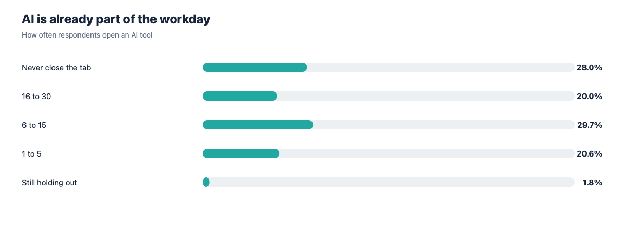
Only 1.8% say they are still holding out. At the other end, 28.0% never close the tab. Another 20.0% open an AI tool between 16 and 30 times a day.
That changes the way we should talk about adoption. For this community, access is not the main issue anymore. The harder questions are what people paste into these tools, which outputs they trust, what gets reviewed, and what happens when the tool is unavailable.
There is also a meaningful difference between frequent use and permanent presence. Opening AI several times a day still feels like using a tool. Keeping it open all day begins to look more like working alongside a system.
What this means for companies: policies designed for occasional experimentation will miss actual behavior. Data handling, review rules and approved workflows need to live where the work happens.
2. People are using AI for work they can feel immediately
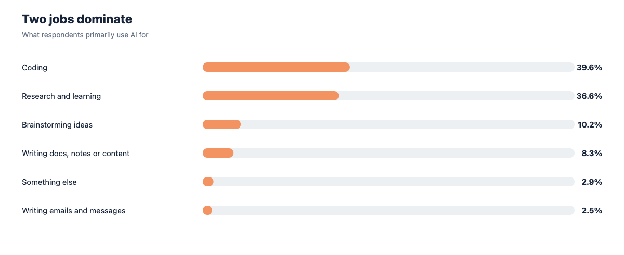
Coding and research/learning account for 76.1% of primary use. Both give people quick feedback like code runs or fails, a research question becomes clearer or produces a new lead, etc. That immediacy may be one reason these workflows have become habitual so quickly.
The career-stage differences are more useful than the overall ranking:
- Students are led by research and learning at 43.3%, followed by coding at 32.7%.
- Professionals are much more coding-heavy: 56.5% choose it as their main use.
- Founders also put coding first at 49.2%, but their remaining use is spread more broadly across research, brainstorming, writing and communication.
The lesson is simple: “AI training” should not be one generic session. A student needs help judging sources and preserving independent reasoning. A professional needs AI to fit testing, review and documentation. A founder needs breadth and speed without turning one model into a single point of failure.
3. The value is real. So is the rework.
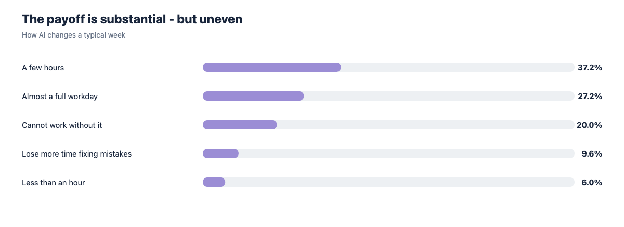
64.4% say AI saves them meaningful time each week, 37.2% save a few hours, while 27.2% save almost a full workday. If that estimate holds even approximately inside a company, the aggregate value can be substantial.
But the answer choices also reveal two different problems that are easy to blur together:
- Dependency: 20.0% say they honestly cannot work without AI.
- Negative value: 9.6% say they lose more time correcting mistakes than they save.
Those are not the same condition. A dependent user may be getting enormous value. A frustrated user may simply have the wrong task, model, context or review process.
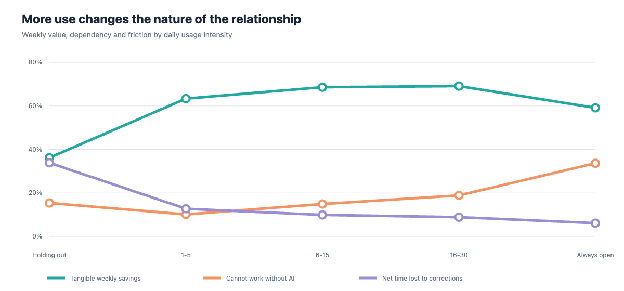
This was one of the most interesting patterns in the survey. Tangible savings rise from light use and peak among people opening AI 16 to 30 times a day. Among always-open users, reported tangible savings dip, while “I cannot work without it” climbs to 33.6%.
We would not treat that as proof that heavy use causes dependence. The survey cannot establish cause. It does suggest that the relationship changes at high intensity. AI may stop feeling like a discrete productivity tool and start functioning as part of the person's operating environment.
4. Trust is not a personality trait. It is a workflow decision.
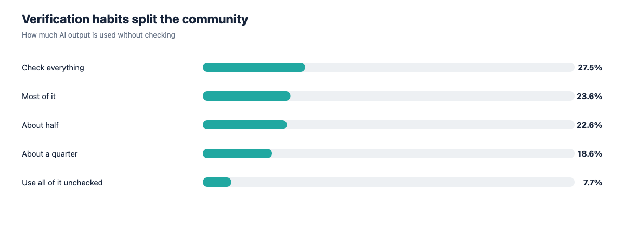
The community is split almost down the middle in a useful way. At one end, 27.5% check everything. At the other, 31.3% use most or all output without checking. Everyone else sits somewhere between those positions.
The job being done matters. High unchecked use is reported by:
- 39.6% of people who mainly use AI for documents, notes or content;
- 33.8% of people who mainly use it for research and learning;
- 27.0% of people who mainly use it for coding.
That does not automatically mean the writing group is reckless. Some outputs may be drafts, internal notes or low-stakes material. But it is a reminder that polished language can travel further than intended. A sentence can look finished long before it has been checked.
Our read: asking people to “always verify AI” is too vague to be useful. Companies need task-specific rules. Brainstorming can tolerate a light touch. Production code, public claims, financial decisions, legal language and customer communication need explicit checks.
5. Manners are part of the interface
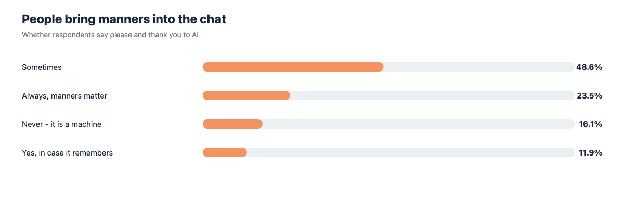
83.9% say “please” or “thank you” at least sometimes. Almost half choose “sometimes,” which may be the most recognizably human answer in the survey. People are not making a philosophical statement every time they type. They are carrying an old conversational habit into a new kind of conversation.
We should be careful not to overread this. Politeness does not prove that users believe the system is conscious. It does show that conversational products activate social instincts. Tone, memory cues and human-like phrasing affect how people judge the relationship.
For product teams, that creates a responsibility. A system can feel socially fluent while still being wrong, forgetful or uncertain. Good design should make those limits easier to see, not hide them behind a pleasant voice.
6. People are not giving up on skill. They are changing what they value.
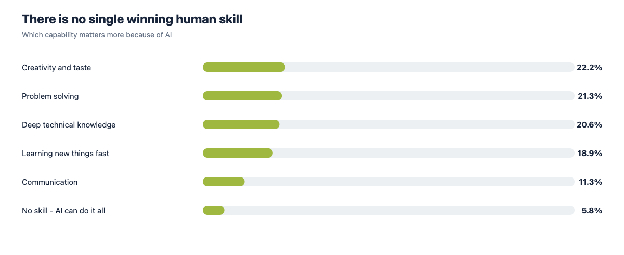
The answers are unusually balanced. Creativity and taste lead at 22.2%, problem solving follows at 21.3%, and deep technical knowledge sits close behind at 20.6%. Learning quickly is not far back at 18.9%.
Only 5.8% say no skill matters more because AI can do it all.
The role differences make the result more concrete:
- Students are almost evenly split between creativity/taste and problem solving.
- Professionals put deep technical knowledge first. That makes sense: expertise is what lets someone notice a plausible but subtly wrong answer.
- Founders stand apart on creativity and taste, chosen by 35.0%. When execution gets cheaper, deciding what deserves to exist becomes more valuable.
There is no single “AI-era skill” hiding in these results. The pattern points to a bundle: frame the problem well, understand the domain, judge quality, communicate clearly and learn fast enough to keep adapting.
7. Most people would cope without AI. A meaningful minority would not.
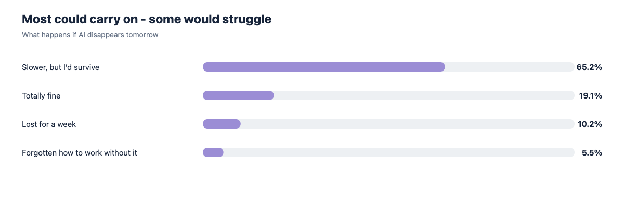
Most respondents are realistic rather than dramatic. 65.2% say they would be slower but would survive, and 19.1% say they would be totally fine.
Still, 15.7% expect serious disruption. They would either be lost for a week or feel they have forgotten how to work without AI.
That is no longer just an individual productivity issue. If important processes depend on model access, AI continuity belongs in business continuity planning. Teams should know where the underlying sources live, how to complete critical tasks manually, and who still understands the work well enough to review it.
The goal is not to force people to work without useful tools. It is to make sure the tool has not quietly become the only place the process exists.
8. The future people imagine is collaborative, not managerial
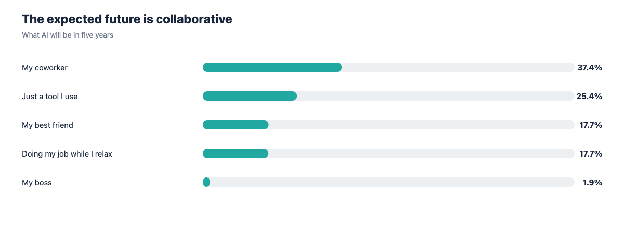
“My coworker” is the most common five-year expectation at 37.4%. A further 25.4% still see AI as just a tool. Only 1.9% expect it to become their boss.
The more interesting answer may be the 17.7% who expect AI to do their job while they relax. That is not necessarily a forecast of unemployment. It may be a wish for delegation, freedom from routine work, or an honest admission that people want the benefit without wanting to manage every step.
Career stage changes the picture again. Professionals are the most likely to imagine AI as a coworker. Students are more likely than the other groups to describe it as a future best friend. Founders are more likely to imagine it doing the job while they step back.
For companies, the coworker framing is useful because it raises better questions than “Which tool should we buy?” Who owns the result? When should the system escalate? What does good review look like? When can a human override it? Those are questions about team design.
The career-stage view in one chart
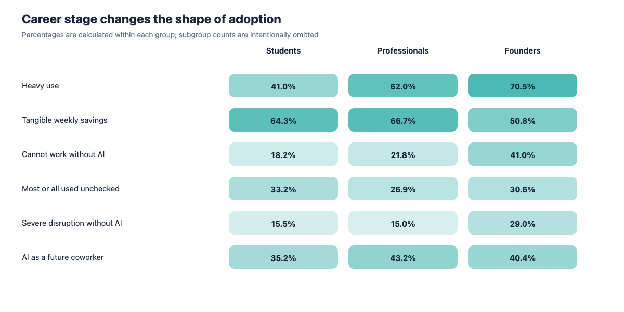
The role comparison is not about declaring one group more advanced than another. Each group is solving a different set of problems.
Students: learning with a shortcut close at hand
Students show the lowest heavy-use rate of the three groups, but a relatively high willingness to use most or all output unchecked. The risk is not simply plagiarism. It is reaching a polished answer before the underlying mental model has formed.
Professionals: integration matters more than novelty
Professionals are strongly coding-led, more likely to keep AI open all day, and more likely to check everything than students or founders. Their challenge is making AI fit real systems: repositories, approvals, customer context and accountability.
Founders: maximum leverage, concentrated dependency
Founders show the highest heavy-use rate and the strongest disruption if AI vanished. They also place unusually high value on creativity and taste. This is the founder trade-off in miniature: AI creates enormous leverage, but concentrating too much work in it creates fragility.
Role comparisons are descriptive. Small differences should not be treated as statistically definitive, and subgroup counts are intentionally not published.
What we would do with this data inside a company
| What the survey shows | The tempting response | A better move |
|---|---|---|
| AI use is already daily | Buy more tools | Identify the few workflows where AI changes cycle time or quality |
| Time savings are substantial | Measure messages or seats | Measure the full loop: drafting, checking, correcting and approving |
| Unchecked use is common | Tell everyone to verify everything | Set review rules based on the consequence of being wrong |
| Heavy use can become dependency | Discourage frequent users | Preserve fallback processes, source access and domain expertise |
| Skills still matter | Run prompt training only | Train problem framing, technical depth, taste, communication and evaluation |
| People expect a coworker | Treat AI like another software licence | Define ownership, escalation, review and override rules |
The common thread is that AI needs an operating model, not only access. People have already supplied the enthusiasm. The work now is to make that enthusiasm reliable.
If you are just getting started
You do not need to redesign your life around AI. Start smaller.
- Choose one task you already understand. If you cannot judge the result, you will not know whether the tool helped.
- Decide what must be checked before you begin. Facts, calculations, sources, permissions and code behavior are good candidates.
- Measure the whole task. Include prompting, review and correction time. A fast draft is not automatically a saving.
- Keep the underlying skill alive. Occasionally do important work without AI, especially when your ability to review depends on first-hand competence.
- Ask for uncertainty, not only answers. Have the system list assumptions, weak points and tests that could prove it wrong.
The aim is not to use AI as often as possible. It is to become more capable without becoming less able to think or act when the tool is absent.
What stayed with us
The most encouraging result is that respondents still place real value on human capability. Creativity, problem solving, technical knowledge and learning all sit near the top. People do not appear to believe that judgment has become irrelevant.
The warning is that habits form quietly. A tab stays open. A draft goes unchecked because it sounds right. A workflow becomes hard to complete without the model. None of those decisions feels momentous on its own.
That is why the next phase of AI adoption will be less about discovering what these tools can do and more about deciding where people still need to remain deliberately involved.