Case study · Into the Scrape-Verse + Zero Downtime SF · August 2026
How Bright Data's CLI went from 300 to 6,000+ GitHub stars
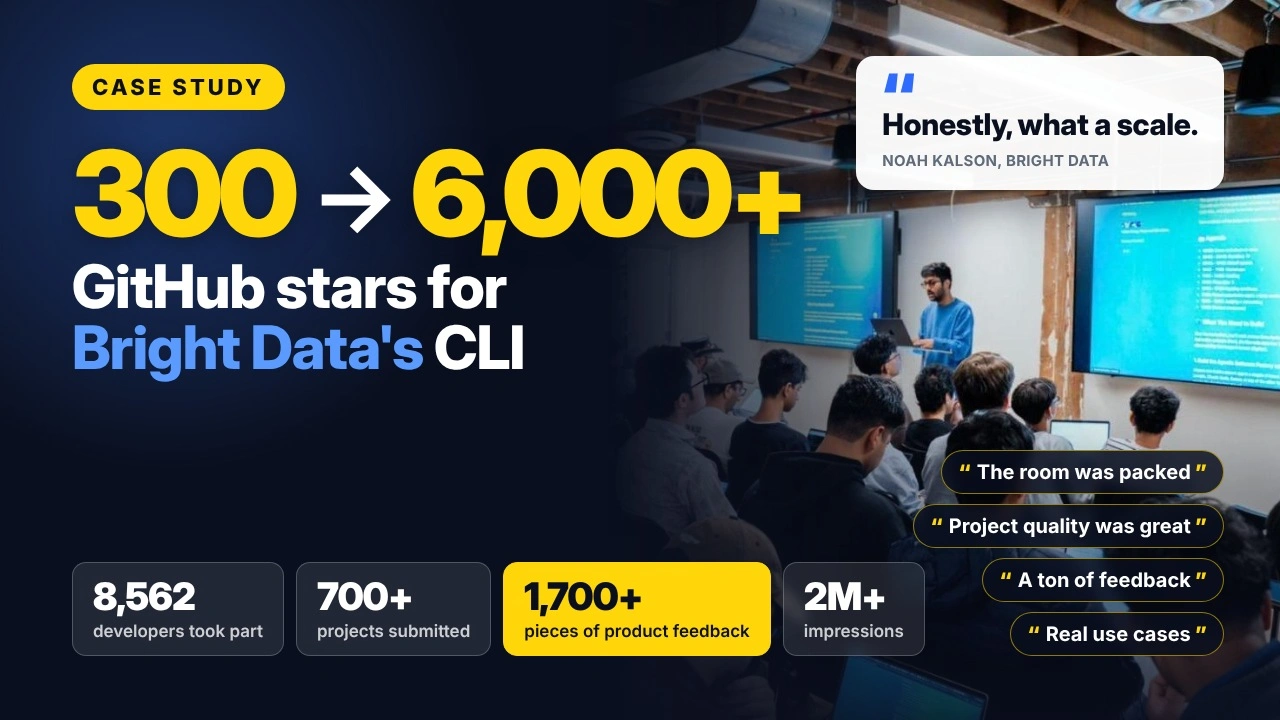
In August 2026, 8,562 developers took part in Into the Scrape-Verse, a WeMakeDevs hackathon built around Bright Data's Scraper Studio. Working in teams, online and in person in San Francisco, they submitted 700+ projects built with the Bright Data CLI, and as they did, the CLI went from about 300 GitHub stars to more than 6,000. They also gave the team more than 1,700 pieces of detailed product feedback and the CLI its biggest week and month of downloads on record.
Scraper Studio fixes a common problem with web scrapers: they break quietly when a website changes its layout. You describe the data you want, AI writes the scraper, and when the site changes, it repairs itself so nothing downstream breaks. Into the Scrape-Verse ran online from 17 to 23 August with $15,000 in prizes, and Zero Downtime brought builders together for a full day at Bright Data's San Francisco loft on 22 August, with Port and SigNoz.
From 300 to 6,000+ GitHub stars
The stars came from the people building with it. The CLI was every builder's starting point for Scraper Studio, so as 8,562 developers signed up and teams submitted 700+ projects, the repo grew from about 300 stars on 1 August to more than 6,100 by 28 August, when star-history.com listed it at number 14 in its GitHub Trending Repositories of the Day. Downloads rose with it: hackathon week was the CLI's biggest week of npm downloads on record. The stars have held and kept growing since, reaching 6,217 on 4 November.
8,562 developers took part
Registration opened on 4 August and sign-ups moved fast: 2,500+ by 8 August, 6,000+ by 13 August and 8,562 by the close. They were the engineers Bright Data sells to, from companies like Amazon, Walmart, JPMorgan, Goldman Sachs, Visa, Google, Microsoft, Meta, NVIDIA, Anthropic, Tesla, Siemens, Accenture and Deloitte, and engineers from Capital One, Wells Fargo, Adobe, Salesforce, AWS and Uber spent the day building in San Francisco.
2 million+ impressions
Kunal's launch Short announcing the NVIDIA DGX Spark giveaway went out on 7 August and has passed 843,000 views. Across all our posts on YouTube, X, LinkedIn and Instagram, plus the WeMakeDevs newsletter, the campaign passed 2 million impressions. Builders added 244 LinkedIn posts of their own, and the top community post on X reached 101,571 views.
What it took
Start with a community that already builds. WeMakeDevs is a community of a quarter of a million developers, and our newsletter reaches 1.8 million people. They know us for tutorials, live streams and hackathons that teach something real, so when we put a product in front of them, they arrive ready to build with it.
Lead with the product. The DGX Spark got people's attention, but everything we published after that was about Scraper Studio: why scrapers break, what self-healing means and where Bright Data fits in a real data pipeline. The brief, rules and judging were built around that one idea, so developers came away knowing what the product does and when to reach for it.
Teach people to use it. Kunal opened the week with a live build, Build Web Scrapers That Fix Themselves, ran a midweek live showcase giving feedback on projects still in progress, and published a video on how to win. Builders had a resources page, a support inbox and the Bright Data team on hand in San Francisco. Teaching is what turns a sign-up into a working project, and a working project is where the stars, downloads and useful feedback come from.
Rules built around self-healing
The brief was "Scrape anything. Break nothing." Every project had to run a real scraper in Scraper Studio, show it repairing itself and connect it to something people use, such as a database or a dashboard. Reliability was one of six judging criteria, and we ruled out any site already covered by Bright Data's 800+ ready-made scrapers, which pushed builders towards the smaller, niche sites Scraper Studio is built for. Every participant got $50 in credits on top of the free tier, and $2,500 in credits went to the top teams so their projects could keep running after the week.
Zero Downtime, one day in San Francisco
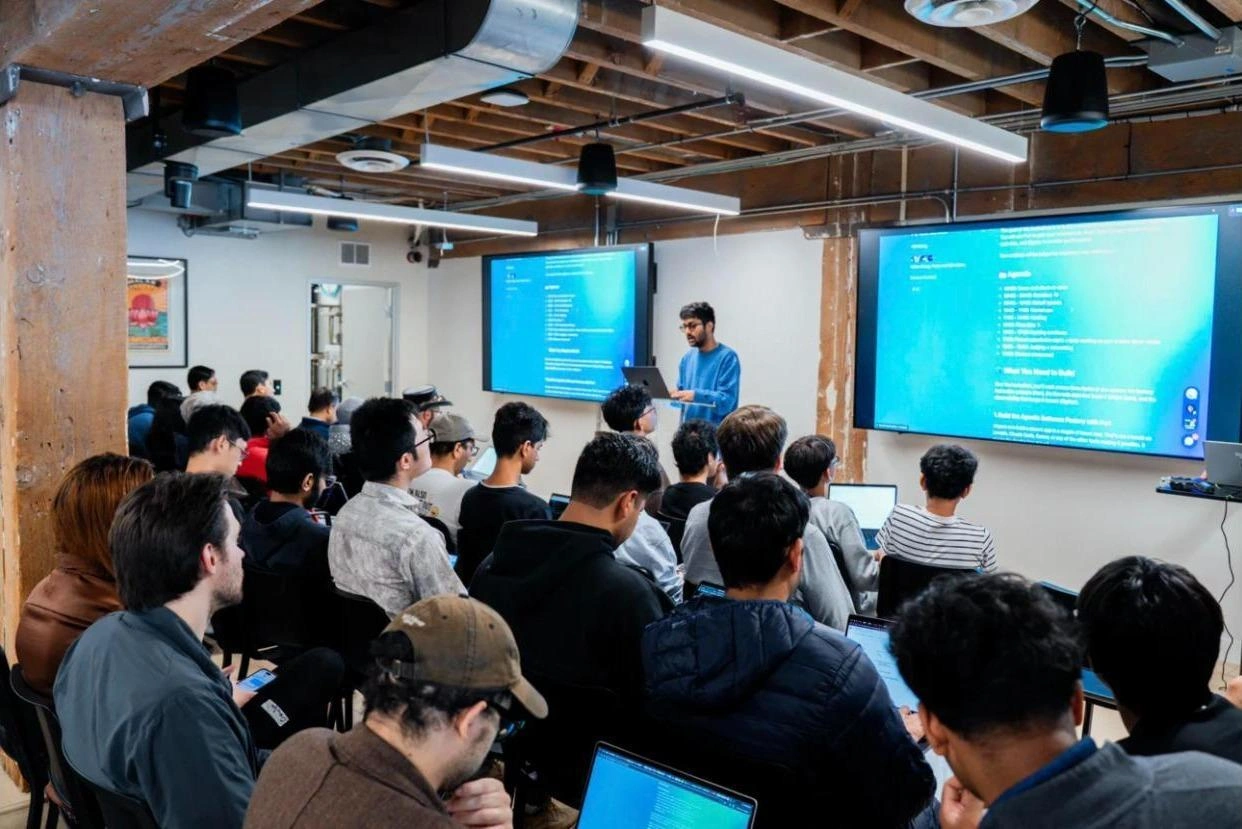
125 builders checked in at Bright Data's loft for Zero Downtime, the in-person half of the hackathon. The Bright Data team showed how to bring live web data into AI workflows, alongside talks from Port and SigNoz, and teams built complete AI systems in a single day. By the evening 39 projects were in, both NVIDIA DGX Sparks had gone to teams from that room, and Bright Data's own team had spent the day building beside engineers from the companies it sells to.
A room full of working professionals. More than 2,300 people signed up for around 130 spots, so the room was curated, and 97% of the people we approved showed up. Going by the job titles attendees gave when they registered, about 80% were working professionals. They came from companies like Meta, Adobe, AWS, Capital One, Wells Fargo, Visa, Uber, Salesforce, IBM, Okta, Nutanix, Unity, Lowe's and Geico, with titles like Principal Software Engineer at Okta, Staff Software Engineer at Unity, Staff Engineer at Nutanix, AI Product Lead at Visa and Senior Engineering Manager at Sunrun, alongside founders of AI startups, including one backed by Y Combinator.
| Working professionals in the room | Share |
|---|---|
| Founders and executives | 44% |
| Engineers and data scientists | 37% |
| Senior engineers, leads and managers | 10% |
| Other professionals (product, research, consulting) | 9% |
Breakdown of the working professionals who checked in, based on the job titles they gave when they registered, not counting WeMakeDevs and sponsor staff.
What developers built
Teams submitted 700+ projects across the online week and the day in San Francisco, and you can browse them in the public gallery with their code and demos. Price tracking was the most popular use case, followed by hiring data and competitor tracking, the same jobs companies already pay for web data to do. Some went well beyond scraping tools: a live feed of UN procurement notices so organisations stop missing deadlines, a research assistant for large solar projects that checks documents against public sources, and a tracker that watches skincare ingredient lists for changes.
| Award | Project | Built by | What it does |
|---|---|---|---|
| Grand prize, NVIDIA DGX Spark | The Scraper Factory | Nitish Mane | A self-healing pipeline where AI agents do the scraping and the repairs, and automated checks decide which fixes go live. |
| Best Use of Bright Data, NVIDIA DGX Spark | Research Factory | Hugh Hoford, Gracelyn N., Ben O'Connor | Tracks new AI research papers, scores how easy each one is to reproduce, and has an agent build the promising ones. Only code that has run reaches a human. |
| Best UI, Apple iPad | ScrapeSentry | Himanshu Kumar | Quality control for scrapers. It checks every result before it ships, holds back bad data and keeps the last good version live until a person approves the fix. |
| Best Clean Code, Keychron keyboards | PriceGuardAI | Shalu Kumari, Jagriti Raj, Kartikey Kesarwani | A price tracker whose scrapers fix themselves. If a fix fails, it shows the last verified price instead of a wrong one. |
| Best Scraper Studio integration at Zero Downtime, Keychron keyboards | Trainable | Aditya Das, Zhiyu Wen | Trains robots in simulation using product data collected from manufacturers' own websites. |
Real usage and product feedback
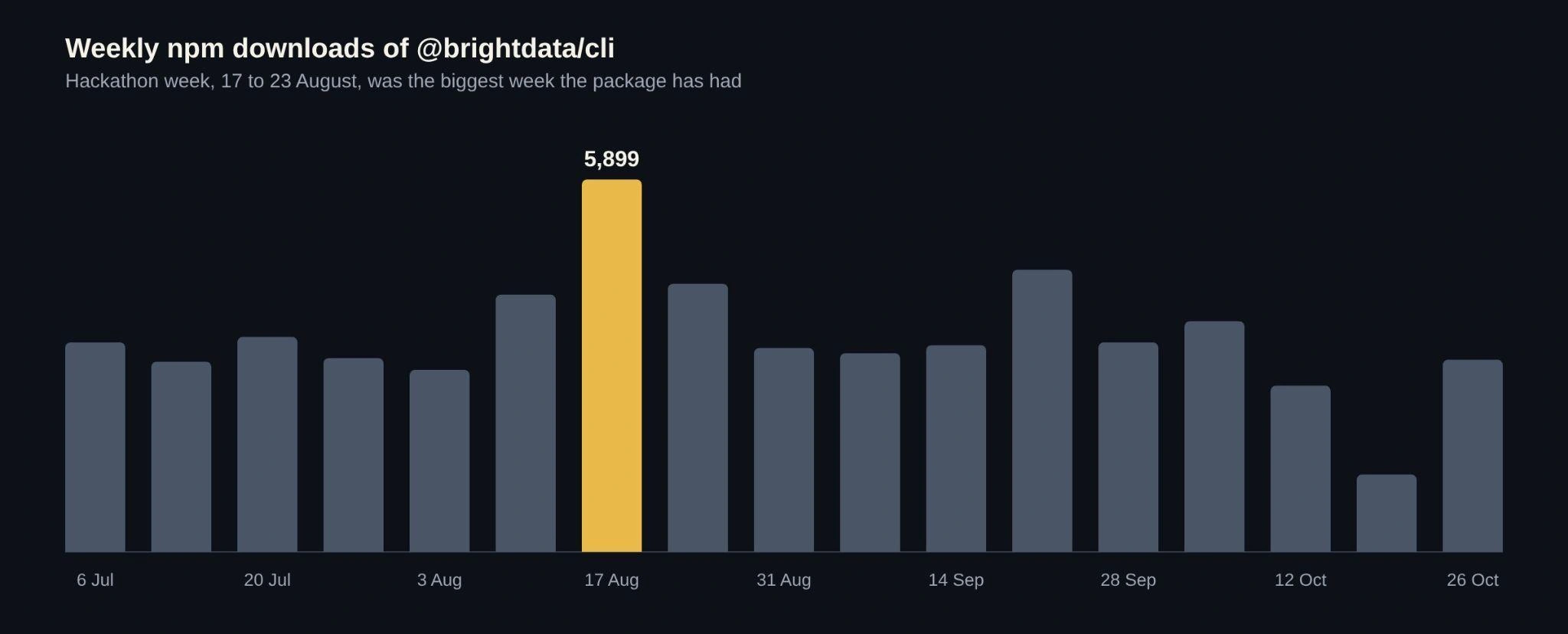
Usage grew alongside the stars. Weekly npm downloads of the CLI went from about 3,000 to 3,400 through July to 5,899 in hackathon week, the biggest week the package has had, and August was its biggest month with 18,836 downloads. By 4 November it had passed 77,000 downloads in total.
The product feedback may be the most valuable part. Every submission asked builders what worked, where they got stuck and what they would change, and because everyone answering had just built something real with the product, the answers were concrete and detailed. The Bright Data team came away with more than 1,700 pieces of quality feedback on the CLI and Scraper Studio from working engineers, the kind that is hard to get from a survey or a support queue.
Some of those builders run data pipelines in their day jobs. Piyush Raj, a software engineer at HSBC, built a competitor pricing monitor that fixes its own scrapers, and Rajkumar Pawar, a software engineer at Accenture, watched his ModelPulse project, with 15 Scraper Studio scrapers tracking AI vendor updates, recover a broken scraper mid-run.
What happened next
Bright Data came back. A week later it sponsored a Best Use of Bright Data track at The Agent Harness Hackathon, again at its San Francisco loft, and it was a sponsor track at Patch the Conference on 24 October. The builders came back too: Nitish Mane, Elijah Umana and Karim Baba all returned for The Agent Harness Hackathon, where Elijah took the grand prize.
What our partners said
"Honestly, what a scale. 8,000 developers joined Into the Scrape-Verse online, the room in San Francisco was packed, and we gave away two DGX Sparks. The project quality was great, we got a ton of feedback from developers, and real use cases for Bright Data came out of what people built."
"Collaborating with WeMakeDevs has been incredibly valuable for Port. From hackathons to meetups, our collaborations have consistently delivered great engagement, results, and ROI.
Kunal is a top-tier community leader with a real talent for bringing developers together and creating meaningful experiences. He's also a fantastic partner, always sharing valuable feedback, fresh ideas, and thoughtful advice to make every initiative better.
Looking forward to many more collaborations with Kunal and the WeMakeDevs community!"
Results at a glance
Bright Data came in wanting three things: reach among the engineers it sells to, real use of self-healing, and honest product feedback from people who had just built with it. Here is how it landed.
| Goal | Result |
|---|---|
| GitHub traction | From about 300 to 6,217 GitHub stars on the Bright Data CLI, and #14 in star-history.com's Trending Repositories of the Day |
| Reach | 8,562 developers took part, and 2 million+ impressions across our posts and newsletter |
| Real usage | 700+ projects submitted by teams, all built on Scraper Studio, plus the CLI's biggest week (5,899 npm downloads) and biggest month (18,836) on record |
| Product feedback | 1,700+ pieces of detailed product feedback from engineers who had just built with Scraper Studio |
| Time in the room | 125 builders checked in (97% of approved guests) from 2,300+ sign-ups. About 80% were working professionals, with engineers and leads from Capital One, Wells Fargo, Visa, Okta, Meta and Adobe |